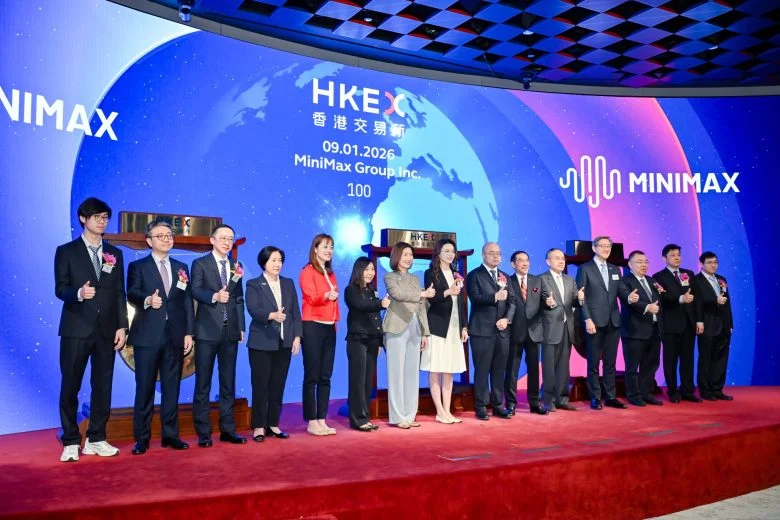
MiniMax, the artificial intelligence company backed by Genshin Impact developer MiHoYo, experienced a dramatic Hong Kong market debut today as its shares soared over 70%. The rally temporarily elevated the firm's market capitalisation beyond HK$90 billion ($11.5 billion), marking a striking entrance for the AI startup.
The company, established by Yan Junjie—a former vice president at SenseTime—commenced trading on the Hong Kong Stock Exchange's main board under ticker 00100.HK. This public offering represents one of the most rapid transitions from founding to listing among global AI enterprises in recent memory.
Why it matters: The enthusiastic market reception signals sustained investor confidence in large language model developers and general-purpose AI platforms. Capital allocation toward this sector remains vigorous even as companies navigate intensifying competitive pressures and escalating research and development expenditures.
Details: Specializing in foundation models and AI-powered applications, MiniMax has assembled a notable investor consortium that includes MiHoYo, the studio behind the globally successful Genshin Impact franchise.
- The initial public offering was priced at HK$165 per share. With full greenshoe option exercise factored in, MiniMax secured HK$5.54 billion ($710 million) in aggregate gross proceeds from global investors.
- Investor enthusiasm proved exceptional, with the Hong Kong retail tranche achieving 1,837 times oversubscription and the international institutional placement garnering 37 times coverage. The offering drew commitments from 14 cornerstone investors spanning Aspex, Eastspring, Mirae Asset, Abu Dhabi Investment Authority (ADIA), Alibaba, E Fund Management, and additional prominent domestic and international institutional players.
- MiHoYo, which provided early-stage angel funding to MiniMax, maintains a 6.4% ownership position now valued at approximately HK$4.8 billion ($615 million) based on current market capitalisation. The shareholder registry also features Tencent, Alibaba, Sequoia China, Hillhouse Capital, and IDG Capital, per public filings.
- ZhenFund distinguished itself by participating across six successive financing rounds, establishing itself as MiniMax's most committed institutional backer. Founding partner Huang Mingming attributed the firm's conviction to Yan Junjie's strategic judgment on pivotal technology decisions, expressing confidence in his ability to navigate the challenging tradeoffs between high performance, cost efficiency, and commercial viability.
- Notwithstanding the robust market valuation, MiniMax disclosed in its prospectus that the company remains in an intensive investment cycle, recording a net loss of $512 million across the initial three quarters of 2025. Founder Yan Junjie indicated that IPO proceeds will primarily fund enhancements to the company's large language model infrastructure and the development of AI-native product offerings. "We will continue striving for advances in intelligence and ensure that cutting-edge AI truly serves everyone," he stated.
Context: MiniMax has engineered proprietary multimodal foundation models encompassing text, speech, and video processing capabilities. The company's abab 6.5 model series leverages a mixture-of-experts (MoE) architectural approach, reportedly achieving performance metrics within 5% of leading US-developed models while operating at approximately 1% of the computational cost. These systems have been deployed at commercial scale across production environments.
- By September 2025, MiniMax's platform had established a presence across more than 200 countries and territories, with international markets accounting for over 70% of total revenue. The company reported 170% year-over-year revenue growth for the first three quarters, accompanied by a gross margin of 69.4%.