Our last Tech Odyssey installment explored how Startup Portugal cultivated a cohesive innovation network across this compact European nation. Now we turn our attention to Bhout, a venture that exemplifies the ecosystem's output.
The heavy bag hanging in Bhout's Lisbon facility appears unremarkable until contact. Unlike conventional equipment, it absorbs impact with minimal oscillation while delivering tactile feedback that approximates striking human tissue. An adjacent display immediately renders strike analytics: force magnitude, velocity vectors, impact coordinates, and kinetic precision.
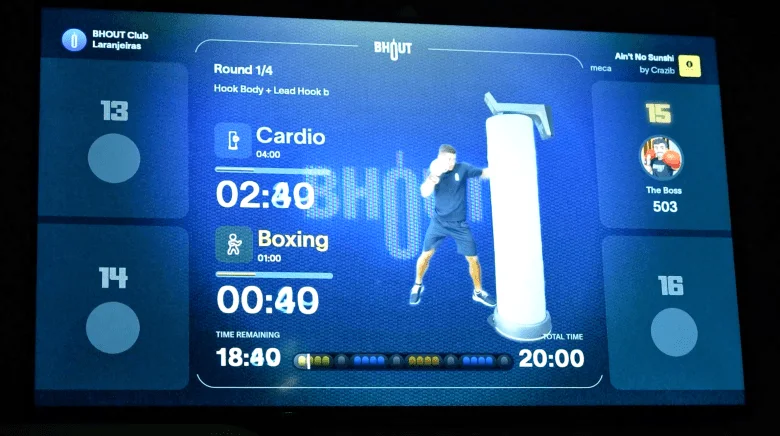
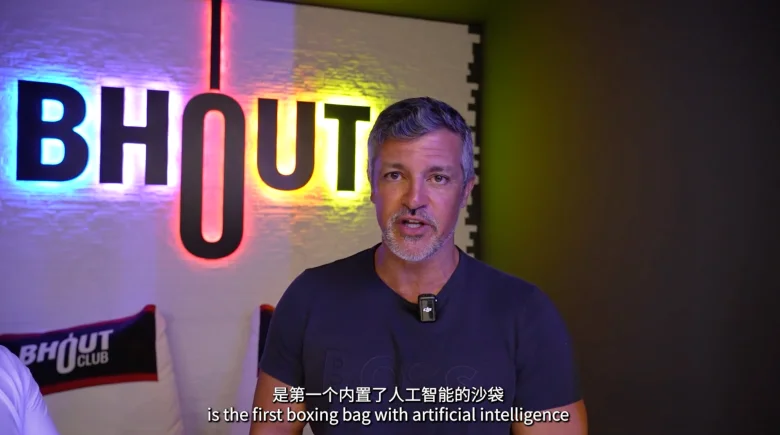
The company positions this apparatus as the first AI-integrated striking platform. Founder Mauro traces its genesis to an aspiration that took root over a decade ago.
Mauro's expertise lies outside engineering—his professional foundation spans martial arts instruction and fitness operations, where he repeatedly encountered the industry's persistent challenge: member attrition. While acquisition proves straightforward, sustained engagement remains elusive. Conventional training cycles breed monotony, and performance gains lack quantifiable markers. Bhout emerged from a straightforward premise: transform physical training into an interactive experience.
Initial development occurred in makeshift workshop conditions. Across six years of iteration, Mauro and his technical co-founder engineered a multi-density striking surface that replicates human anatomical resistance. Distributed sensor arrays interface with stereoscopic vision systems to capture comprehensive strike telemetry—impact force, strike velocity, spatial accuracy, and physiological fatigue indicators stream in real time.
This biometric feedback architecture gamifies the training paradigm. Each strike generates point values that populate facility-wide competitive rankings. The platform's adaptive algorithms calibrate workout parameters against individual anthropometrics, fitness baselines, and training objectives, accommodating everyone from novices and youth participants to elite combat athletes.
Application domains extend beyond commercial fitness. The technology now supports neuromotor rehabilitation protocols for Parkinson's disease management and close-quarters combat conditioning for defense personnel.

Bhout launched its flagship Lisbon facility four years ago. The company reports it now ranks as Portugal's highest-margin boxing venue. The operational architecture prioritizes scalability: traditional reception infrastructure is absent, with reservation systems, class scheduling, and facility management executing through software automation.
By late 2025, Bhout had established distribution agreements with over 500 fitness facilities globally, extending its footprint from Iberian markets through North American territories including the United States and Mexico. The Asia-Pacific region represents the next expansion phase. Mauro indicates the company will inaugurate its inaugural Beijing location in 2026.
Bhout's trajectory mirrors a defining characteristic of Portuguese startups: global orientation from inception. Constrained domestic market dimensions necessitate international scaling as a fundamental growth vector.
Yet for Mauro, the narrative's foundation remains unchanged from its origin point eleven years prior—an aspiration that refused to fade.